Trigger & Spoiler Warning:
This article will discuss sensitive topics such as alcoholism, depression and suicidal thoughts, ableism, and combat PTSD. There will also be spoilers for character heart events and community projects for Stardew Valley 1.6.
Depictions of mental health in the media we consume are important in shaping our perception of these issues. One popular cozy game has a surprising amount of depth to characters that have been analyzed numerous times by fans: Stardew Valley.
For those who are not cozy gamers, Stardew Valley is a farming and life simulation game in which you leave your corporate job to take over your grandfather’s farm. This farm is located in a small coastal town called Stardew Valley. The residents here all have their own backstories and personal querks. These individuals will be the subject of our discussion today.
From alcoholism to PTSD, let’s dive into part one of this mental health media analysis.
Alcoholism – Pam

There is not much information provided on Pam’s backstory other than that she used to be the bus driver until the bus broke down. If you complete the community center, or buy the bus stop project from Joja, she will resume this job. Which makes her addiction that much more concerning…
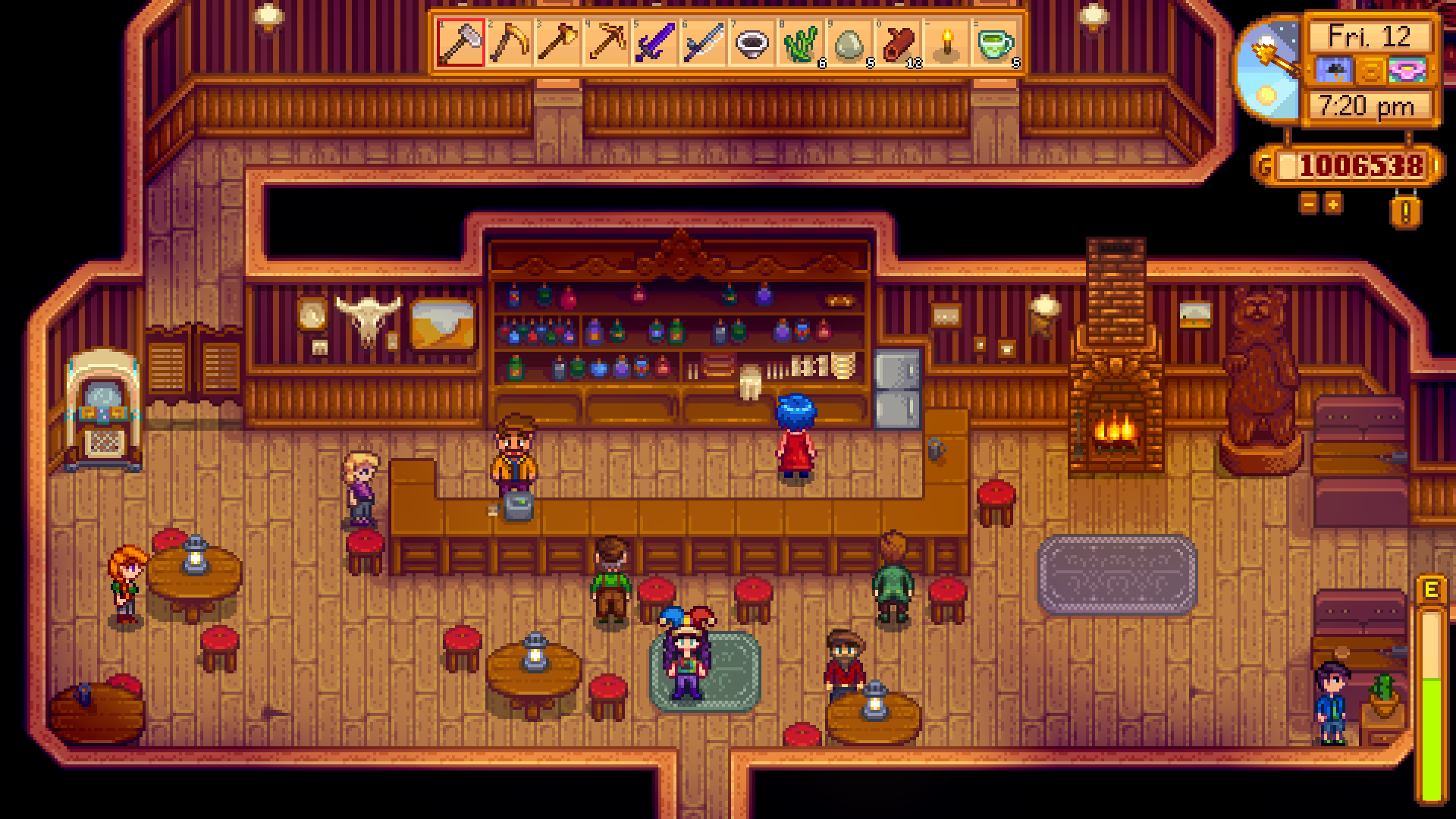
Much of Pam’s dialogue revolves around alcohol and you will even get a few jobs from her to make ale or “potato juice”. She can be found at the saloon every night, sometimes unresponsive. Penny, Pam’s daughter, also remarks about her mother’s frequent drinking and their financial situation. The two live together in a trailer that is surrounded by trash. Both characters express embarrassment of their living conditions at various points. They also both mention having difficulties affording food at the local store. At one point, Penny mentions that Pam started drinking more after she lost her job. This may point to a trigger for this character and helps demonstrate the complexity of alcoholism.
After you have Robin build them a house, Pam will express gratitude but will admit that she is still having trouble getting sober. So, like many in real life, she will turn to religion as a support. Despite this new revelation, we won’t see a change in her behavior. She will still appear at the saloon every night and have the same dialogue around alcohol. Now it can be argued that this might just be a technical limitation with the code – definitely not my area of expertise – so take that as you will.
Alcoholism & Depression – Shane

Shane is a standoffish bachelor that lives with his aunt Marnie and his goddaughter Jas. This character’s story is one of the most talked about because of his development and candid conversations about depression. In the early game, Shane tends to come across as rude. Like Pam, he can be found at the saloon almost every night and he often talks about drinking.
His underlying depression becomes evident during his first friendship event. During this, he shares a drink with the player and describes feeling like he’s trapped in a “miserable abyss”. This helps contextualize his perceived rudeness toward the player. Oftentimes, feelings of depression and helplessness can cause us to create distance from others. Along with drinking, this is a coping mechanism for Shane. The second major friendship event gives us a glimpse of how Shane’s addiction impacts his home life. Marnie gets into an argument with Shane about his drinking and questions him about his future plans. Shane makes a comment that he will “not be around long enough to need a plan”. His young goddaughter overhears this and runs away crying. Just like with Penny, we can see how addiction impacts the entire family – not just the individual. The following event is perhaps the darkest in the game with us having to talk Shane down from a cliff – literally.
The next few scenes we get with Shane are much more positive. For the next event, I do have to criticize Marnie’s backhanded comment, although I can understand where she is coming from. Shane walks into the house seemingly in a good mood. Marnie jokingly asks if there was a sale on beer. Annoyed, Shane states he has reduced his drinking and is happy because he feels better. He also remarks he has more spending money and presents Jas with a gift, which she gleefully accepts. While I feel like Marnie’s comment is awful and can be discouraging, this is an important inclusion to have in the game. It is reflective of comments people struggling with addiction often receive. This also demonstrates how even those who support us can say negative things to express their own exhaustion or frustration.
Shane’s final friendship event (excluding the romance events) shows him working with Jas in the barn. A popular wholesome scene, it really demonstrates his development. Unfortunately despite this, we see little change in behavior just like in the case of Pam. His dialogue will be more positive and friendly, but he still goes to the saloon every night. Even more worrying, should you decide to marry him, his spouse room will still be a mess littered with what we can infer are beer cans. Recovery is not a linear road. That could be one explanation for this. Or he could just be drinking sparkling water like he stated earlier. But I will leave that up to you to decide how his story goes.
Disability – George

George is often referred to by the community as the “town grump”. He fills the somewhat stereotypical role of the old cranky guy. However, like Shane, he will soften with the player over time and reveal the reason for his rough exterior. George is wheel chair bound which becomes a center point in a few friendship scenes.
In Penny’s first friendship event, we see her attempt to help George in retrieving his mail. Without asking, she moves his wheelchair. George reacts negatively to this, asserting he did not need help. Although George does apologize for snapping, this scene is an important reminder to not make assumptions in our attempts to aid others. Everyone likes to feel independent and like they are able to do things for themselves. This is something those in the disability community often struggle with. Although you will lose friendship points for doing so, I think pointing out to Penny that asking first would have been the better move is the right option here.
Harvey’s first friendship event also is important for George. The doctor is doing an in-home appointment for George who is being argumentative with him. I again have to be critical of another character here as Harvey neglects to recognize the fact George is simply trying to assert his autonomy. The guidance Harvey was trying to give was good advice; but the way he responds in saying that he went to medical school for eight years comes across as condescending. Instead he should provide George with options or more information on why he thinks this is the best decision. This approach would provide George with greater control over his own health and create a more collaborative environment. I wish we could suggest something like this but unfortunately our options are either to tell George to follow Harvey’s advice or tell the doctor that George knows his body best. Sadly, many people with disabilities face this type of treatment in medical settings. This can lead to resistance (like we see in George), medical avoidance, or anxiety.
The final scene we will discuss is the only scene actually connected to George’s friendship points. In this one we see George struggling to reach a book so we retrieve it for him. Despite the scene we likely already saw with Penny, we don’t ask first. However, George does not get angry this time but instead tells us why he is in a wheelchair. He says that everyone assumes it is because he is old but he was actually paralyzed years ago in a mining accident. This scene is powerful in getting us to recognize and address our own biases. Few players predicted this going in which demonstrates just how ingrained some stereotypes are.
PTSD & Guilt – Kent

Kent, the husband of Jodi and father to Sam and Vincent, is a character we don’t get to meet until the start of year two. Before we even get to meet him, we learn he is a soldier fighting in the war against a neighboring nation. Definitely a dark backdrop to this seemingly lighthearted world. A note from Kent to Jodi can be found next to their bed. In the note, Kent warns that he is not the same man he once was but that “no matter how I act, you and the kids mean everything to me”. This note is good foreshadowing to the man we will meet.
It does not take long to realize that Kent is struggling to adjust back to civilian life and deal with the trauma he has faced. He will occasionally talk about his difficulties in random dialogue. If you give him a hated item he will state “This… They gave this to me in Gotoro prison camp. I’ve been trying to forget about that. *shudder*”.
During our only friendship scene with him, we witness a post-traumatic stress trigger. Jodi is making popcorn and Kent bursts into the room yelling at the sound. He snaps at Jodi and we have to choose how to respond. The only response that will grant you positive friendship points is to say “I know you’re hurting… but don’t blame your wife”. Kent will appreciate the fact you defended his wife and apologize. If you decide to blame Jodi, he will get angry with you and tell you to stop turning him against his wife. On the other hand, if you lie and tell him you asked for the popcorn he will be mad at you for lying. While this is a tense scene, it does show the underlying character in Kent. He struggles with the angry outbursts that can be a symptom of PTSD but does really care about his wife, honesty, and personal responsibility.
His care for his children is also evident in his dialogue. Kent will state that Sam is all grown up and share his regret that he was not able to be there for him. He will also make comments about how you know Sam better than him. While not as direct as his PTSD, we can see the manifestation of guilt that often comes from situations such as this. Those in the military or high demand jobs often struggle with guilt for not being present enough for their children. We see Vincent practically jump with glee at the return of his father and we can only hope that Kent is able to see this.
Final Thoughts
Stardew Valley does a great job at representing various mental health struggles you would not normally expect to find in a cozy farming sim. The candid, straight forward conversations help show the reality of these issues without watering them down as we often see in the media. That being said, there is still room for improvement. There are concerns about certain characters falling into stereotypes. Additionally, while we see some character development, late game depictions do not reflect the lasting change we are expecting. Regardless, this game has opened up discussions on mental health and has captured the hearts of many.
I would like to thank ConcernedApe for giving us this amazing game to begin with.
A thanks is also due to everyone that has contributed to the Stardew Valley Wiki over the years. This was a valuable tool in fact checking quotes, getting portraits, and is a must have for anyone playing the game.
Finally, thank you for taking the time to read my silly game analysis. Please let me know below if you find mental health media analyses like this interesting or if you have your own thoughts on the characters mentioned. Until next time!
Leave a Reply